September 2026 Scam Pulse: Student-loan rescue, disaster aid, and fake bank alerts
Before you pay for repayment help, respond to a disaster appeal, or move money after a security alert, verify who is asking.
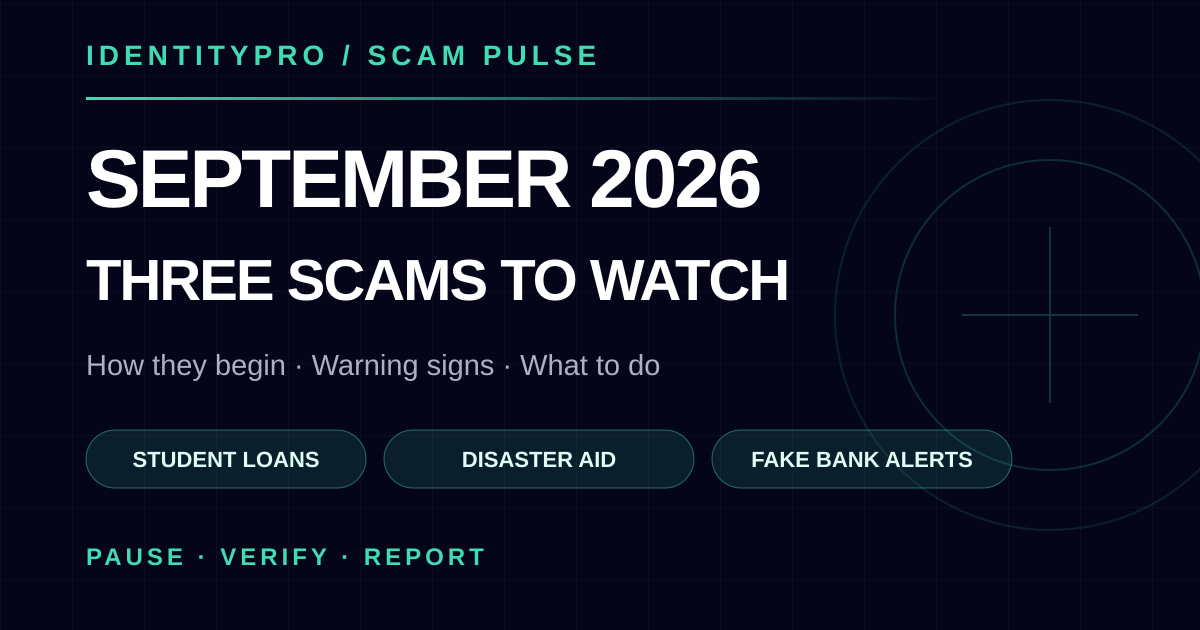
Pause before you use the supplied link or number.
End the call or stop replying to the message. Close the ad or social-media profile. Find the organization’s official site yourself and use its contact details to check the sender, offer, or debt.
How these three scams reach you
Swipe or scroll to compare all columns.
| Scam | Typical opening | Safest first move |
|---|---|---|
| Student-loan repayment scams: Don’t pay for a “SAVE rescue” | An offer to save your payment plan or obtain forgiveness for a fee | Check your actual notice through StudentAid.gov or your servicer. |
| Disaster-recovery scams: Fake aid, contractors, and charities | “Pay us and we’ll help you qualify for FEMA money” | Verify the aid agency, contractor, or charity independently. |
| “Protect your money” scams: Fake bank alerts and crypto ATMs | A supposed bank fraud alert tells you to move money for safety | Hang up before moving money. Call the number on your bank card. |
Calls, messages, and ads
Student-loan repayment scams: Don’t pay for a “SAVE rescue”
Enrollment in federal repayment and forgiveness programs is free. You do not need to pay a third party to access them. Source: Paying for school and avoiding scams — FTC Consumer Advice
The first SAVE transition deadlines fall in late September, but yours may be later. Edfinancial says borrowers have 90 days from the date their notification is sent. Check your own notice through your account; do not ignore a legitimate servicer notice.
How does it begin?
An unexpected caller, message, or ad offers to preserve an affordable payment, switch your plan, or secure forgiveness for a fee. The New York Attorney General’s September 2 warning describes scammers exploiting changes to federal student-loan programs.
What are the warning signs?
- Guaranteed forgiveness or a promise to erase your debt quickly
- Claims of government affiliation or special access to federal programs
- Upfront charges to arrange repayment help
- Requests for your Federal Student Aid username or password
- Pressure to pay immediately before a supposed relief window closes
What should you do?
Type StudentAid.gov into your browser or contact your actual servicer using contact details you checked yourself. Read the notice and deadline in your account before acting. Keep your Federal Student Aid login private, even if the caller claims to work for your servicer.
If you already paid or shared information
- If you shared your login, change the password through StudentAid.gov and anywhere you reused it. Contact your actual servicer to check for unauthorized account changes.
- If you paid, report the fraud to your bank, card issuer, or payment provider promptly. Ask whether they can stop or refund the payment.
- Save the pitch, messages, and receipts. Report the scam to the FTC; use IdentityTheft.gov if your identity information was exposed.
Doorstep pitches, messages, and relief appeals
Disaster-recovery scams: Fake aid, contractors, and charities
FEMA does not charge application fees. A demand for money to help you qualify for FEMA funds is a scam. Source: Avoid scams after weather emergencies — FTC Consumer Advice
A reasonable contractor deposit may be appropriate. Agree on a documented payment schedule, keep receipts, and hold final payment until the work is complete and you are satisfied.
How does it begin?
Someone offers access to disaster aid for a fee. Other pitches promise immediate repairs or solicit donations for survivors. September is National Preparedness Month: the FTC’s September 9 alert urges readers to prepare for the scams that follow emergencies.
What are the warning signs?
- A fee to apply for FEMA assistance or qualify for funds
- A contractor demanding full payment upfront or an immediate signature
- Refusal to provide license, insurance, or written contract details
- Pressure to donate before you can check the charity and who receives the money
What should you do?
Check aid eligibility through DisasterAssistance.gov. Before hiring, verify the contractor’s license and insurance and get a written estimate and contract. Research a charity before donating. Confirm its payment instructions on its official site rather than trusting a social post or message.
If you already paid or shared information
- Save the aid offer, contract, donation appeal, messages, and payment records.
- Contact the bank, card issuer, or payment provider promptly about a fraudulent payment and ask what recovery options remain.
- Report fraud to the FTC and contractor problems to your state attorney general. If someone used your identity, start a recovery plan at IdentityTheft.gov.
Fake bank alerts and calls
“Protect your money” scams: Fake bank alerts and crypto ATMs
In 2025, the FBI’s Internet Crime Complaint Center received 13,460 complaints involving cryptocurrency kiosks, with approximately $389 million in reported losses. Source: 2025 cryptocurrency kiosk complaint data — FBI IC3
These complaints can include other payment methods within the same scam. The total is not necessarily money deposited through kiosks alone, and it is not a September 2026 loss figure.
How does it begin?
A supposed bank security alert says your account is compromised. The caller insists you stay on the phone, keep the conversation secret, withdraw cash, and deposit it at a crypto ATM using a supplied QR code. That code sends the money to a wallet the scammer controls.
What are the warning signs?
- Instructions to move money to make an account safe
- A caller who stays on the line and directs each withdrawal or transfer
- Secrecy demands or coaching on what to tell bank staff
- A supplied QR code for a crypto-ATM deposit
- Requests to buy gift cards or hand cash or gold to a courier as alternative ways to “protect” funds
What should you do?
End the conversation before withdrawing or transferring money. Contact your bank through its official app or the number on your card. The CFTC warns that legitimate institutions will not direct you to move money through crypto ATMs, gift cards, or couriers. Talk with someone you trust before acting on an unusual payment instruction.
If you already paid or shared information
- Stop sending money. Use your bank’s official app or the number on your card to contact the bank and secure affected accounts.
- Contact the crypto-ATM operator or exchange immediately. Report the fraudulent transaction and ask what stopping or refund options exist. Recovery is not guaranteed.
- Preserve receipts, the kiosk location, wallet address, transaction ID, and messages. Report the scam to FBI IC3 and the FTC.
What should you do if you already responded?
You sent money
Contact the payment provider immediately and report fraud. For a crypto-ATM payment, contact the operator or exchange and ask about stopping or refund options. Keep receipts and transaction details; recovery is not guaranteed.
What to do if you were scammed — FTC Consumer AdviceYou shared account credentials
Change exposed passwords through the official site, including anywhere you reused them, and turn on multi-factor authentication. For a Federal Student Aid login, also contact your actual servicer to check account changes.
Paying for school and avoiding scams — FTC Consumer AdviceYou shared identity information
If you disclosed a Social Security number or other identity information, use the FTC’s guided recovery steps and contact the affected financial institutions.
Build an identity-theft recovery planSomeone now offers to recover your money
Be wary of a follow-up caller or message offering recovery for an upfront fee. Do not send another payment or disclose financial information to claim a supposed refund. Verify any organization independently.
Watch for scammers offering recovery help — FTC Consumer AdviceSources and methodology
We chose these stories for their relevance in September, the harm they can cause, and the steps readers can take to avoid them. We reviewed primary sources through September 16, 2026. This is an editorial selection for U.S. consumers, not a ranking of September’s most prevalent scams. The first two stories draw on the New York Attorney General’s September 2 warning and the FTC’s September 9 National Preparedness Month alert. The account-protection story draws on CFTC guidance. The FBI figures count 2025 IC3 complaints involving cryptocurrency kiosks and losses reported in those complaints, including other payment methods. They do not measure all fraud, September 2026 losses, or losses through kiosks alone. Borrowers should verify their own servicer notice and deadline.
- September student-loan scam warning — New York Attorney General
- Paying for school and avoiding scams — FTC Consumer Advice
- SAVE transition notice and individual deadlines — Edfinancial
- Access your federal student-loan account — Federal Student Aid
- National Preparedness Month scam warning — FTC Consumer Advice
- Avoid scams after weather emergencies — FTC Consumer Advice
- Research charities before donating — FTC Consumer Advice
- Check disaster assistance and apply — FEMA
- Unusual money transfer instructions may signal fraud — CFTC
- Crypto payment scams and supplied QR codes — FTC Consumer Advice
- 2025 cryptocurrency kiosk complaint data — FBI IC3
- Report internet-enabled fraud — FBI IC3
- What to do if you were scammed — FTC Consumer Advice
- Watch for scammers offering recovery help — FTC Consumer Advice
- Report fraud to the FTC
- Build an identity-theft recovery plan
- Find your state attorney general — USA.gov
Consumer education only. IdentityPro is not a government agency, law firm, tax adviser, or investment adviser. Read our Scam Pulse editorial policy.
Credit, identity, and privacy monitoring
IdentityPro combines these services in one place, with restoration support if identity theft happens.